
About Henry Gibbs
-
Helping others has been important to me from an early age. I was 10 when my mum first introduced me to the world of holistic therapies. She had just become a Reiki master and asked me if I would like to try it. So began a journey of inquiry, study and discovery that led me through the years to my present integrated acupuncture practice.
The journey included my first experience of Five-Element treatment, which came from one of J R Worsley’s early students. It made such an impact that my appreciation of myself and the human condition was changed permanently.
-
My training in acupuncture and the Chinese healing arts began with a four-year degree course at the College of Integrated Chinese Medicine. There I studied a spectrum of Chinese Medicine that included both the Five-Element and Traditional Chinese Medicine (TCM) disciplines. My studies culminated in 2015 when I was accredited with a BSc (Hons) degree and became a Licentiate in Acupuncture.
I previously attained my International Therapy Examination Council (ITEC) accreditation in Holistic Massage in 2011. Combining this with acupuncture as well as my knowledge of Reiki, I have cultivated a personal form of hands-on therapy that is inclusive and particular to the individual.
-
I am lucky enough to have been able to practise in different countries and with different cultures over the past 15 years. I’ve worked in community clinics in Copenhagen and Kenya and have now returned to the U.K. to further the work of community holistic healthcare. Humans are indeed very diverse creatures – my experiences have given me first-hand knowledge of how to account and care for that diversity.
‘Often in life we can travel away from ourselves and get lost. Then one of the most joyful journeys we can make is finding our way back home again.
‘After treatments I often hear people say, “I’ve got my old self back” or “I feel myself again.” For me that indicates the real depth and benefit of the integrated acupuncture approach.’
The harmony of balance

In ancient China, a complex model of understanding was created to decipher the mysteries of the human Body/Mind/Spirit connection, the Tao being the guiding force.
I view treatment as a journey of inner revelation that creates outer harmony, which involves integrating a balance of the polarities – Dark and Light – that exist within us.
This understanding of balance is best symbolised by the Yin-Yang philosophy, which is one of the guides that we use to appreciate a person’s internal harmony.
TCM – Traditional Chinese Medicine
TCM is a system of diagnosis and treatment that uses the principle of Yin-Yang balance, applying it to the understanding and treatment of many bodily conditions, including muscular/skeletal symptoms.
The Yin-Yang principle is as intrinsic to TCM as Aristotelian logic is to Western medicine. It is a simple concept, yet it may take many years to understand its application in the physical realm.
On the philosophical side, we can interpret Yin nature as darkness, shade, a still lake, the moon, rest and peace – Yang nature would be light, brightness, a flowing river, activity and action.
These states are what we call polarities and their correspondences. Instead of labelling them as separate entities as we would in western logic, we see them as opposite but complementary states, able to exist as both themselves and their opposite. They are mutually exclusive, meaning they are actually dependent on each other and cannot exist without each other! As Lao Tzu, the leading Taoist philosopher, said, “In order to contract, it is necessary first to expand.”
When we apply these ideas to the body, we start to see that there are many places in which this simple relationship is existing and not always in balance. With the aim of bringing Yin-Yang into harmony, we practitioners will most of the time work on either adding more Yin or Yang where it is deficient or eliminating it where it is excessive.
This system is incredibly useful to help people struggling with hard to manage symptoms whilst also aiming to alter their internal imbalances.
Five-Element Acupuncture
Five-Element Acupuncture is a healing philosophy, rooted in Taoism. It is a prism through which we can find the way to understand the relationship between our organs, our emotions and nature itself.
Each of us inhabits our own individual complex of the five elements: Earth, Metal, Water, Fire and Wood.
The guiding principle of a Five-Element treatment is that one of these Elements is out of balance from the rest – and will have been that way from early life.
If the imbalance can be detected and treated effectively then profound change can take place in a person’s spirit.
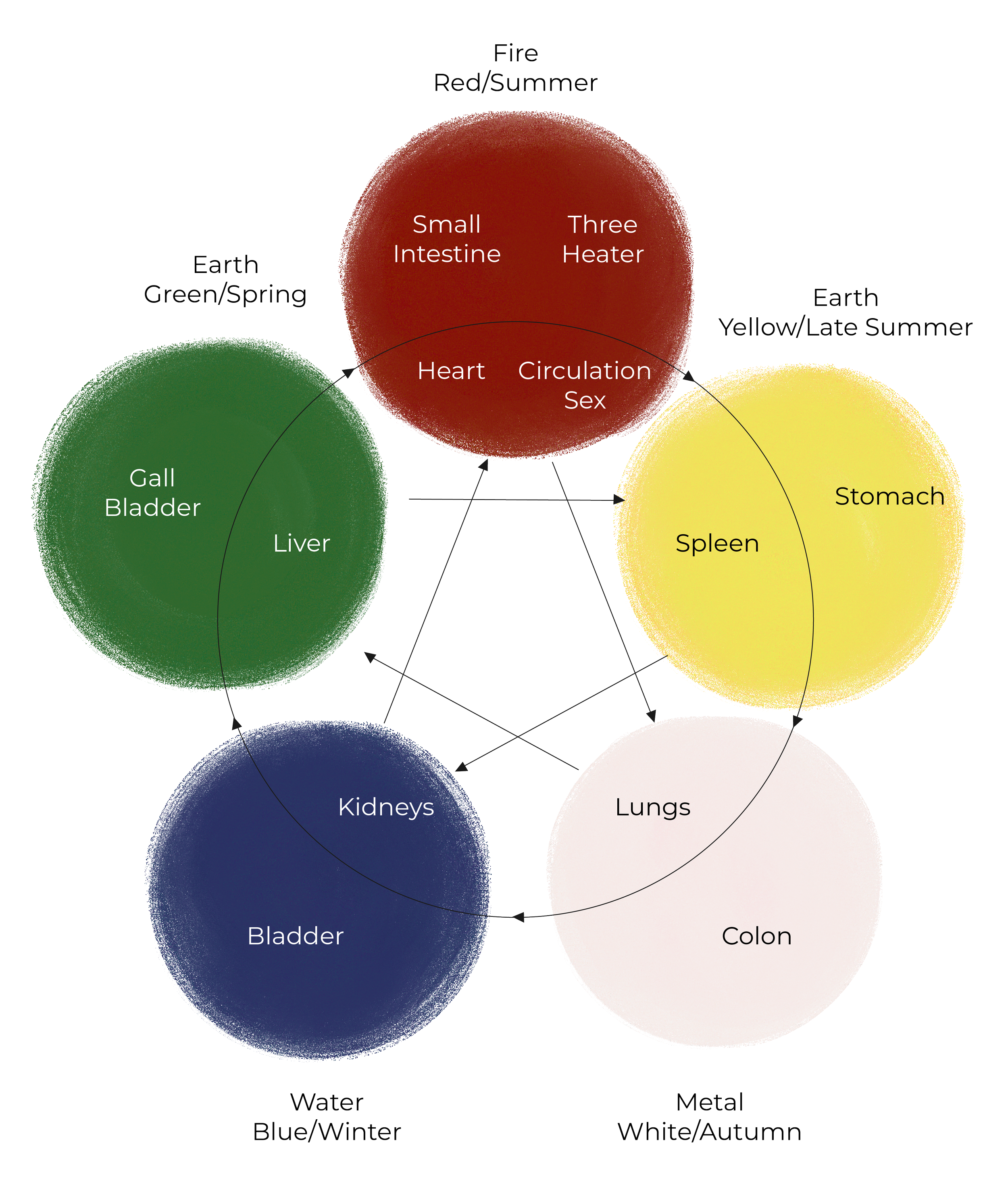
The Five Elements
J R Worsley
Founder of the College of Traditional Chinese Acupuncture
In the West, our understanding of the Five-Element principles comes primarily through the interpretations of a man named J R Worsley. Having studied under two Masters in China during the 1950s and 60s, he founded the College of Traditional Chinese Acupuncture in Leamington-Spa in the 1970s and began teaching a new wave of practitioners who spread this ancient knowledge to a new generation in a new society.